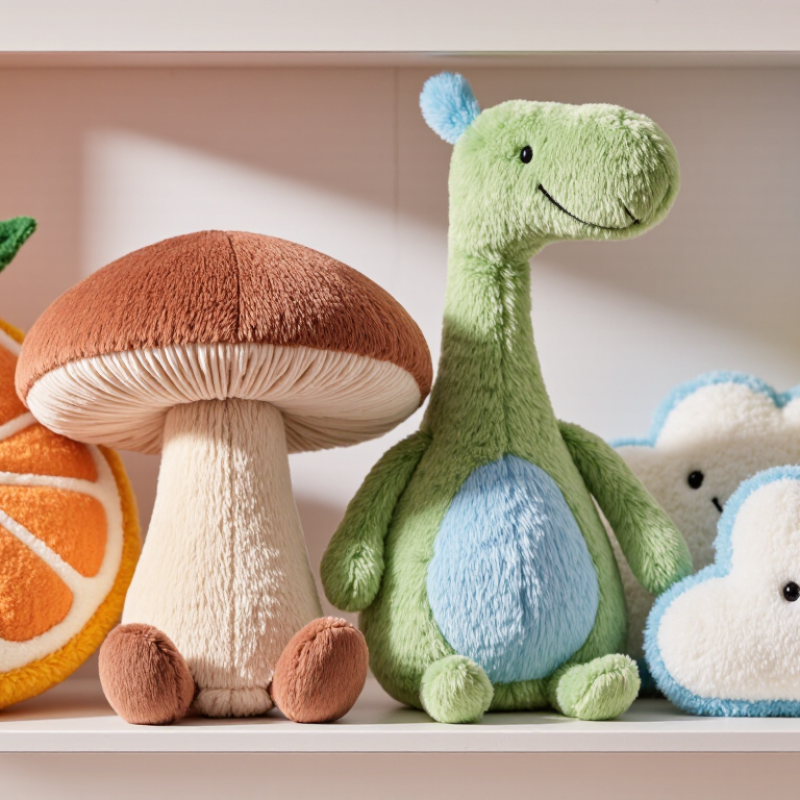
Unique Shaped Stuffed Toys are plush companions designed beyond the familiar bear, bunny, or dog. They may resemble a slice of fruit, a cloud, a tiny house, or an imaginary creature. Their unusual outlines, embroidered faces, and tactile fabrics make them easy to notice on a shelf. Small details matter.
The market context helps explain their appeal. Grand View Research’s Plush Toys Market report estimated the global market at about $10.4 billion in 2023, with continued growth projected through 2030. This is a market estimate, not a guarantee that every novelty design will sell. Still, it points to sustained consumer interest in plush products. The Toy Association’s trend reporting also highlights personalization and expressive play as recurring themes in toys. Unique shapes can support both, though the idea alone is not enough.
A well-designed shape should feel appealing in a child’s hands, not merely look striking in a product photo. Consider a soft, rounded mushroom with stitched gills, or a long-necked creature that can sit without tipping over. Fabric feel, seam quality, washable care instructions, and age guidance deserve equal attention. Sometimes the strangest design is awkward to cuddle. That is worth admitting. This guide explains what makes these toys distinctive, how they are designed, and what buyers should check before choosing one.
What Defines a Unique-Shaped Stuffed Toy? Form, Function, and Classification
What Are Unique Shaped Stuffed Toys?
A unique-shaped stuffed toy is defined by more than an unusual outline. Its form changes how it looks, feels, or is handled. A crescent pillow with short legs, for example, may combine a familiar animal face with an abstract body. Rounded corners, a flattened base, and visible seam lines give the shape a tactile identity. The boundary is fuzzy. A toy can be novel in silhouette yet still follow a familiar animal classification.
Form and function help explain the difference. Long, narrow limbs invite gripping, while a broad, soft body works well for hugging or display. Grand View Research estimated the global stuffed and plush toys market at about USD 11.8 billion in 2023, with projected annual growth of 7.2% through 2030. That figure covers a broad product category, not uniquely shaped toys alone. Still, it shows the scale of the market in which shape-led designs compete for attention.
A practical classification can group toys by silhouette, use, and visual reference: geometric forms, food-inspired forms, creature hybrids, and functional shapes such as neck cushions. These groups overlap. That is useful, but imperfect. A pear-shaped creature may be both food-inspired and animal-like. Designers also need to consider how stuffing affects the form: a sharply pointed tip may collapse, while a tightly packed seam can feel stiff. Shape should remain recognizable after handling, not just in a product photo.
What Are Unique Shaped Stuffed Toys? - What Defines a Unique-Shaped Stuffed Toy? Form, Function, and Classification
| Shape category |
Typical form |
Common function |
Classification cues |
Illustrative example |
| Food-inspired |
Recognizable foods or dishes, often simplified into soft, rounded forms |
Play, collecting, or decorative display |
Classified by the food item represented rather than by an animal species |
A plush strawberry with embroidered seeds |
| Geometric or abstract |
Basic or irregular shapes such as spheres, stars, clouds, or cushions |
Comfort, decoration, or sensory play |
The outline is the main identifying feature; it may not depict a specific character or object |
A star-shaped pillow with soft filling |
| Hybrid creature |
A fictional figure combining features from two or more animals or imaginative forms |
Pretend play, storytelling, or collecting |
Features from different source forms are intentionally combined |
A fictional creature with a cat-like face and dragon-style wings |
| Object-shaped |
A soft representation of a familiar everyday object |
Imaginative play or room decoration |
The silhouette and details refer to a non-living object |
A plush backpack-shaped toy with stitched pockets |
| Functional or wearable |
A toy form adapted for an additional practical use or for wearing |
Play plus a secondary use, such as carrying, resting, or wearing |
Has a recognizable toy shape and a feature designed for another use |
A plush neck pillow shaped like a crescent |
| Articulated or transformable |
A stuffed toy with movable parts, folding sections, or a changeable configuration |
Interactive play and pose variation |
Construction allows parts or the overall form to move or change position |
A soft toy with jointed limbs attached by fabric seams |
Classification is based on a toy’s visible form and intended use; a single stuffed toy may fit more than one category.
How Pattern Pieces and 3D Assembly Create Nonstandard Plush Shapes
Unique-shaped plush toys begin as geometry, not decoration. A crescent, dumpling, or curled animal may need curved panels, a side gusset, and carefully placed darts. Each piece changes the volume. Designers translate a flat pattern into a three-dimensional shell, then test how fabric stretches around tight curves. Small shifts matter. Move one seam, and the silhouette can become lopsided.
Pattern planning also controls how stuffing moves through the toy. Wide openings help fill narrow limbs; hidden gussets add depth without forcing one oversized panel. During sampling, makers may clip seam allowances near curves and turn the shell slowly to avoid puckers. That part is tactile. Still, a neat sample can hide problems. Dense filling may distort a pointed tip, while soft fabric may collapse after handling. The U.S. Consumer Product Safety Commission’s 2022 toy-related injury report recorded 145,500 emergency-department-treated injuries among children 12 and younger. It covers all toys, not plush alone, but highlights why seams and attachments deserve careful checks.
Prototypes should be checked from several angles, with stuffing weight and seam stress recorded. An eye-level photo is not enough. Squeeze the crown, gently tug the limbs, and see whether the outline returns. Record what fails. Pattern revisions are rarely elegant; an extra gusset may improve balance but add labor and a visible seam. That trade-off deserves a second look.
Materials and Fill: How Fabric and Fiberfill Affect Shape Retention
For a stuffed toy with pointed ears, a curled tail, or a rounded belly, fabric choice affects how clearly each feature holds its shape. Tightly woven fabric usually resists stretching, helping narrow corners stay defined. Knitted fabric has more give, so soft curves feel natural but may relax with handling. Check the fabric’s stretch in both directions before cutting; a small test piece can reveal surprises.
The filling matters just as much. Polyester fiberfill is light and easy to distribute, but loose handfuls can shift and leave dents. Add small amounts at a time, pushing filling into tips with a blunt tool. Firm packing can sharpen a shape, yet too much pressure may strain seams or make the toy feel stiff. Not always obvious. A narrow arm often needs less fill near its joint than at its end.
For an informed choice, make a sample using the same fabric, seam allowance, and filling planned for the toy. Squeeze it, set it down, and check whether it springs back or stays flattened. If the sample will be washed, follow the fabric and filling care instructions, then inspect it again after drying. I’ve found this test useful, though hand-stuffing can still leave one side slightly fuller. That small unevenness is easy to miss until the toy sits upright.
Safety Benchmarks: ASTM F963-23 and the CPSIA 100 ppm Lead Limit
A plush toy shaped like a crescent, fruit, or tiny house can hide safety concerns in its details. ASTM F963-23, the U.S. toy safety standard recognized by the CPSC, addresses mechanical and physical hazards, flammability, and chemical requirements. For unusual shapes, check projecting parts, stitched-on decorations, and seams that could open and expose filling. Small details matter. A smooth-looking surface is not proof of compliance.
The CPSIA limits total lead in accessible component parts to 100 parts per million, when technically feasible. Surface coatings have a separate 90 ppm lead limit. These limits matter for more than fabric: accessible trims, painted details, and attached components may need evaluation. The CPSC’s 2023 toy-related injury report estimated 231,700 emergency-department-treated injuries among children aged 14 and younger; this figure covers toys broadly, not stuffed toys alone. It is useful context, not a prediction of risk for any one design. Ask for test documentation tied to the finished toy and its materials. I would also inspect stress points after repeated squeezing. Paperwork helps, but it cannot show every weak seam.
Age-Grading Checks: CPSC Small-Parts Cylinder (31.7 × 57.1 mm)
Age-grading checks for uniquely shaped stuffed toys should include more than the plush body. A decorative horn, detachable shoe, plastic eye, or loose fabric accessory may create a small-part concern. The CPSC small-parts cylinder measures 31.7 × 57.1 mm. If a component fits completely inside the cylinder under the applicable test procedure, it may be classified as a small part. Do not force or compress it to make it fit. Small details matter.
For toys intended for children under three, small-part restrictions may apply, subject to specific rules and exceptions. Age grading should reflect the toy’s design, play pattern, and likely users, not just its label. Review removable pieces and attachments, and consider whether they could come loose during reasonably foreseeable use. Testing protocols may also require checking components after use-and-abuse tests. A gauge is not a verdict.
Odd shapes can make inspection less straightforward. A soft stitched tail may seem secure, yet its seam can weaken with repeated pulling; a rigid ornament may detach cleanly. That difference deserves attention. Record what was tested, how it was tested, and any uncertainty. Recheck design changes, even small ones. A new stitch or accessory can alter the assessment.
Conclusion
Unique Shaped Stuffed Toys are plush items whose forms differ from familiar animals or simple geometric designs. Their distinctive silhouettes can be decorative, playful, or functional, but their shape depends on how the toy is designed and assembled. Pattern pieces cut from fabric are joined through seams and three-dimensional construction techniques to create curves, angles, and unusual proportions. Fabric choice and fiberfill density also influence softness, firmness, and how well the toy retains its intended form over time.
A well-designed toy should balance its shape with durability and age-appropriate safety. Seams and materials should be assessed for everyday use, while relevant safety checks may include ASTM F963-23 requirements and the CPSIA limit of 100 ppm lead in accessible materials. Age grading should also consider whether detachable components could present a choking hazard, including evaluation with the CPSC small-parts cylinder, which measures 31.7 × 57.1 mm. These considerations help make distinctive plush designs practical as well as appealing.